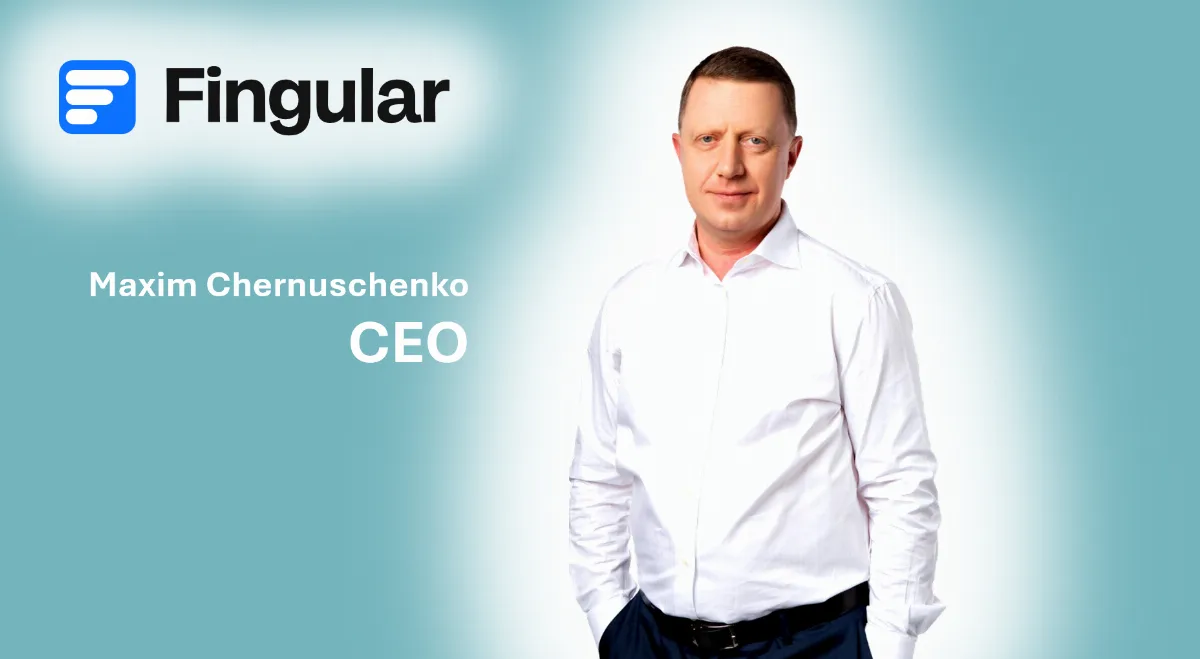
by Maxim Chernuschenko, CEO of Fingular
Singapore-based global neobank Fingular, launched in late 2021, is a salient example of a next generation neobank. Late last year Fingular surpassed the milestone of 5 million customers and achieved operational Breakeven in just 3 years since inception. The neobank, that call itself the Bank of the Southern Hemisphere, aims to become the bank for 2 billion financially underserved people around the Globe, wherever they are, and drastically improve their life quality. Why the problem of social injustice in financial inclusion is still acute and how cutting-edge technologies allows to fight it, we discussed with the CEO of Fingular, Maxim Chernuschenko.
According to the World Bank, more than 2 billion people are still financially underserved. Why is this still the case? Why can’t they get a loan given thousands of banks and financial institution around the Globe? There are many reasons. Insufficient level of official salary, distance from the office of a conventional bank, lack of the required documents leads to the fact that people cannot get a loan from traditional financial institutions. In some countries up to a third of the population still live without documents for historical reasons. Online players sometimes offers tough conditions, and neobanks, that have become new classic, usually focus on the developed segment of the population, and winning over traditional banks in competition due to convenient online one-click services. Moreover, neobanks are divided into two classes: global, but not focusing on credit products (rather transactions and remittance), or representing the widest functionality, but in one market only. Our feature is that on the one hand we are global, on the other hand we are credit-led, and finally, unlike others, we are Risk-savvy from day one, we knows how to serve those who are refused by our competitors. We help such clients to build a successful credit history, improve financial literacy and move them up the ladder of financial experience. By involving them in the financial system, we stimulate the economy of countries as a whole. Our primary goal is to rapidly improve the quality of life of 2 billion people around the World Is the globality you are aiming for a consequence of this your goal? Is the problem of financial inclusion same across countries and continents? There are over 2 billion financially underserved clients worldwide, and the vast majority of these clients are concentrated in the Southern Hemisphere. Exactly, in five key macro-regions – Southeast Asia (over 350 million financially underserved people), South Asia (over 500 million), Sub-Saharan Africa (over 400 million), Middle East Northern Africa (over 100 million) and Latin America (over 300 million). Since the approaches to serving such clients are largely the same, and we initially built our hyper-automated architecture without human staff, our goal is to become a bank without borders for 2 billion, providing the best customer-centric affordable financial services for all these people, wherever they are. We have a proven ability to launch a new country from scratch in less than 3 months. 70% of our IT code is the same for all countries, 20% is easily customizable, and only 10% requires serious customization to a specific market. From a business perspective, this approach allows us to consider a global neobank as an extremely well diversified investment portfolio with an appropriate portfolio management logic and risk limit control for one market. Regarding specific countries, of course, the share of financially excluded people varies greatly, for example, in Malaysia less than 10% of the population does not have bank account, while in Bangladesh, Pakistan and Egypt the share of such clients exceeds 60%. Over time, as these segments become involved in the financial system, we expect a boom in retail at all, so such countries are very promising and attractive in the long term. What is the most important thing for success in serving such financially underserved clients? On the one hand, smart procedures for assessing risk and forecasting customer behavior, on the other hand, the key factor of success is the offering most convenient, understandable, and customer experience-oriented products. Another key thing is a smart limit policy. We use the Low-and-Grow Strategy and it works indeed. When competitors reject the client, we provide him exactly as much as he can comfortably pay, then increasing the limit as his path develops. What do you consider as the ultimate goal from a product perspective, what products are more suitable for people without experience in financial ser…
About Fingular
Fingular, launched in Singapore in 2021, is an independent financial group founded by European entrepreneur Maxim Chernuschenko, backed by Cypriot investor Vadim Gurinov. Steered by experts from over ten countries with backgrounds in finance, IT, product development, sales, and marketing, the company offers entirely digital and automated services, meeting the daily financial needs without requiring human intervention. Fingular has already rolled out digital financial services in Indonesia, Sri Lanka, Malaysia and India, surpassing the 5 million customer milestone, and aims to become a major global player serving over 30 countries by 2030. Website https://fingular.com
Das Briefing
Die Tech-Woche in einer E-Mail.
Die lesenswerten Beiträge der Woche. Jederzeit abbestellbar.